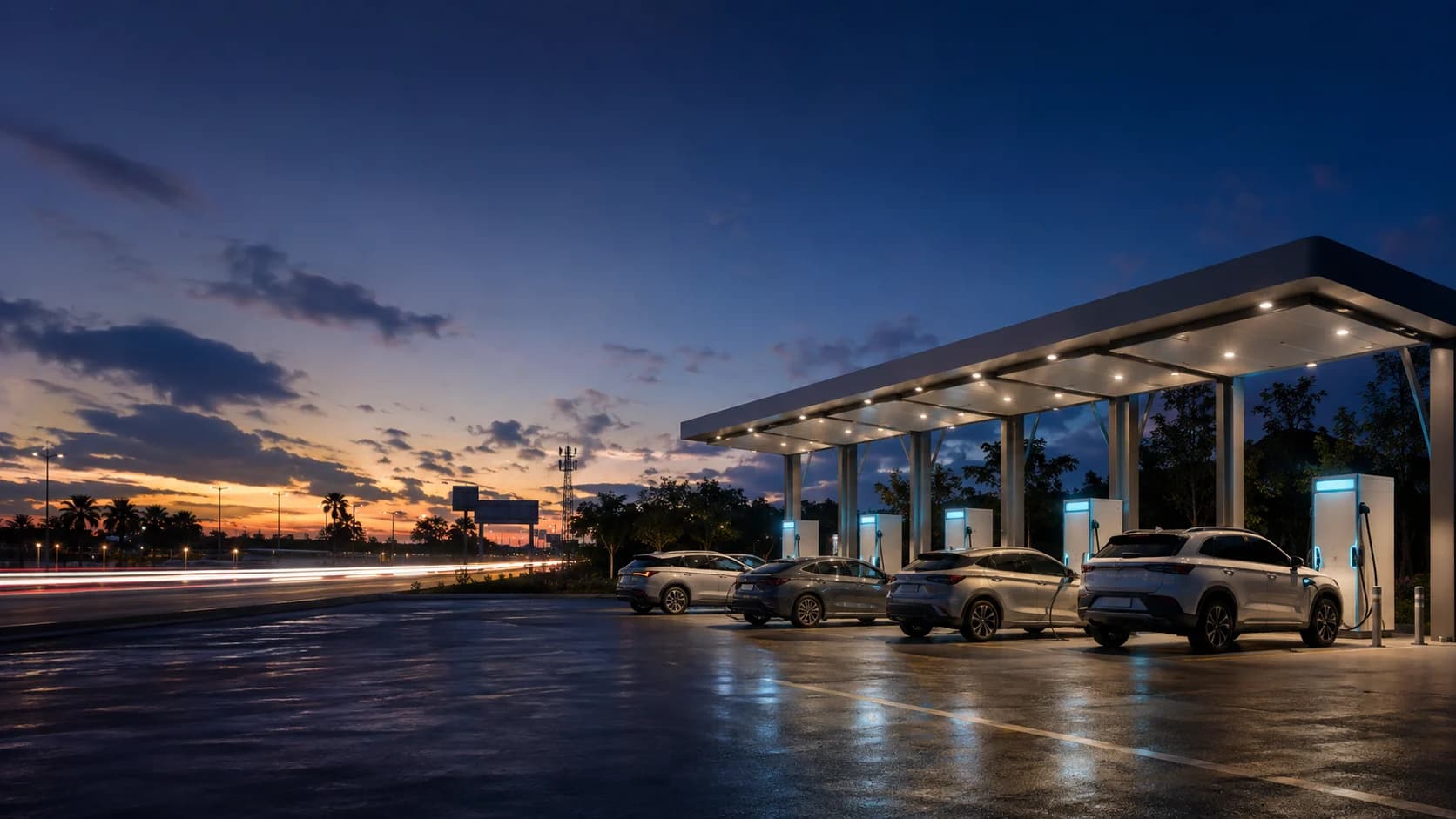
EV Charging Station Franchise in India
An independent guide to the EV charging station franchise opportunity in India — how the operator models actually work, what a site costs before and after subsidy, what drives returns, and how to judge whether a site is worth funding. All rupee figures are Vinfast Auto Dealer estimates unless a government or operator source is cited.

Vinfast Auto Dealer Editorial
Independent EV & dealership investment analysts
Automotive-finance analysis — CAPEX/OPEX & dealership ROI modelling.
Updated 31 July 2026
An EV charging station franchise is an arrangement where you supply the site, the civil work and the power connection, and a charging operator supplies the hardware, software, branding and network. You earn a margin on every unit of electricity dispensed. It is the lowest-capital way into EV infrastructure, and it is the fastest-growing format we track.
This page covers the market, the operator models and how to evaluate a site. For the line-by-line cost build-up and ROI modelling, see our charging station franchise cost and ROI guide.
- Public charging stations
- 52,718
- Of which fast chargers
- 16,561
- Subsidy window open to
- March 2028
Where these numbers come from
How big is India's EV charging market?
India had 52,718 public EV charging stations as of July 2026, 16,561 of them fast chargers for cars — figures reported to Parliament by the Ministry of Heavy Industries. That fast-charger share matters more than the headline: most of the installed base is slow AC hardware, so the segment an investor is actually entering is far smaller than 52,718 suggests.
The direction of travel is set by policy rather than by demand alone. PM E-DRIVE targets roughly 72,300 public charging stations, against FAME-II supported 8,932 public chargers with ₹912.50 crore under the previous scheme. That is roughly a fourteen-fold step up in ambition, and it is the reason this category is growing faster than any other EV format we track.
The honest counterweight: a subsidised build-out target is not the same as demonstrated demand at your site. Chargers are being funded faster than EV parc is growing in many districts, which is precisely why utilisation — not capital — is the number that decides whether your site works.
What does an EV charging station cost to set up?
Vinfast Auto Dealer estimates under ₹15 lakh for a single AC point and ₹40 lakh to over ₹1 crore for a multi-gun DC fast-charging site, before any subsidy. The spread is wide because the charger itself is often not the biggest line — sanctioned load, the transformer and civil works usually dominate a DC site.
Treat any single “EV charging franchise cost” figure you find online with suspicion, including ours. The number is meaningless without the site type, the power available and the subsidy category — and as the next section shows, subsidy can move the investor’s actual outlay by most of the total.
How much subsidy can you get under PM E-DRIVE?
Between 70% and 100% of the cost, depending entirely on where the site is. This is the most important and least-discussed fact in the category. Most pages quote a setup cost and stop, which materially overstates what an investor funds.
| Support | Condition | |
|---|---|---|
| Government premises, residential colonies, hospitals, educational institutions | 100% of upstream infrastructure AND charging equipment | mandatory free public access |
| High-traffic public sites — railway stations, airports, bus terminals, metro, municipal parking, ports, fuel outlets, toll plazas | 80% of upstream infrastructure + 70% of charging equipment | public access required |
| Shopping malls, markets, roadside highway facilities | 80% of upstream infrastructure | equipment funded by the operator |
| Battery swapping / battery charging stations, any location | 80% of upstream costs | — |
Three things an investor should read off that table. First, the 100% category requires mandatory free public access — you are not funding it, and you are not charging for it either, so the commercial logic is different from a revenue site. Second, subsidy released in two tranches against performance benchmarks, so you fund the build and recover it rather than receiving money up front. Third, Bharat Heavy Electricals Ltd (BHEL) is the project implementation agency.
Charging-infrastructure support extended to 31 March 2028. That is worth noting because the two-wheeler component of the same scheme was not extended on the same timetable — the charging window is the part that remains open.
How do the operator franchise models work?
The common structure is a split: you bring the site and the operations, the operator brings the hardware, the software and the brand. Beyond that shape, terms are negotiated site by site rather than published.
Tata Power’s EZ Charge partner programme is the clearest publicly documented example. On its own page, Tata Power describes screening sites, installing stations, supplying the technology and maintaining uptime, while the partner scouts and secures the site, runs daily operations, maintains equipment and promotes locally. It states that registration fees are not applicable.
What no operator publishes
What to ask an operator before you commit
- What is the revenue split per unit dispensed, and who sets the retail tariff?
- Who owns the hardware at the end of the term, and who pays to replace it?
- What uptime is guaranteed, and what happens commercially when it is missed?
- Is the territory exclusive, and how far away can the operator place the next site?
- Who carries the cost of the sanctioned-load upgrade if the site needs one?
- What are the exit terms if utilisation never reaches the modelled level?
What actually drives returns on a charging site?
Utilisation, and almost nothing else. A charger is a fixed-cost asset earning a thin margin per unit dispensed. Doubling utilisation roughly doubles gross margin against an unchanged cost base, which is why two sites with identical capital can produce completely different outcomes.
The three variables worth modelling
- Utilisation hours per day. Model this conservatively and stress-test it downward. It is the number most likely to be optimistic in an operator’s projection.
- Tariff-to-price spread. Your margin is the gap between the commercial electricity tariff you pay and the price you may charge. Both can move, and in many states the retail price is constrained.
- Sanctioned load and demand charges. DC fast charging needs substantial sanctioned load, and demand charges accrue whether or not vehicles arrive. This is the cost that punishes low utilisation hardest.
Our ROI calculator lets you put your own utilisation and spread assumptions in rather than accepting a projection. For the full cost build-up behind these variables, see the charging station franchise cost guide.
How do you evaluate a charging site?
Judge a site on three things, in this order: power, traffic, then commercials. Investors routinely reverse that order and negotiate terms on a site that was never going to get the load it needed.
- Power availability. Can the site get the sanctioned load, at what cost, and how long will the discom take? This kills more charging projects than any other factor and it is the first thing to check, not the last.
- Dwell time and traffic. Charging needs vehicles that stay put. Locations where people already wait — malls, highway food stops, transit hubs — beat high-traffic locations where nobody stops.
- Subsidy category. Which PM E-DRIVE bracket the site falls into changes your funded cost more than any negotiation with an operator will.
- Competitive proximity. Chargers are being funded aggressively. Check what is already installed and what is approved nearby before assuming demand.
Who should not invest in an EV charging franchise?
Anyone who needs predictable near-term cash flow, and anyone without secured site control. We say this as independent advisors with no operator relationship: this category is being promoted heavily, and enthusiasm is running ahead of demonstrated site-level returns in many districts.
The format suits an investor who already controls a suitable site, can fund the build and wait for reimbursement, and is willing to hold through a slow utilisation ramp. It suits an investor chasing quick returns on borrowed capital very badly. If your territory has thin EV registrations and several approved chargers already, the honest answer is often to wait — and that is the answer we will give you.
If you are weighing this against vehicle retail or another format, our EV franchise comparison sets the options side by side, and our free eligibility check gives you a read on your specific territory.